What a sports summer! The European Football Championship, the Tour de France and Wimbledon were barely behind us, and all eyes have been focused for a few weeks now on the next sports highlight: the Olympics.
Major sporting events attract millions of viewers worldwide every edition. For sports fans, these events are a time of excitement and joy. But these events also provide the perfect opportunity for companies to capitalize on the sports craze by launching creative advertising and marketing campaigns.
While athletes compete for titles and fame, however, another battle is going on behind the scenes: the protection of intellectual property and portrait rights.
While it may be tempting to capitalize on the hype of a major sporting event, or a special sporting event such as Remco Evenepoel’s double gold, this marketing strategy carries legal risks. A common pitfall when creating a commercial campaign is ignoring intellectual property and portrait rights. The unauthorized use of these rights can lead to legal action, damages and reputational damage.
Therefore, before launching a marketing campaign as a company, it is crucial to understand the rules of the game.
Intellectual rights and sporting events: what’s at stake?
The economic value of major sporting events can hardly be overstated. Organizations behind these events, such as the International Committee (IOC), FIFA and UEFA, generate revenue not only from ticket sales and the sale of broadcasting rights, but also (and primarily) by entering into sponsorship and advertising agreements. And then there are the rights of the individual athlete.
Given the huge financial stakes, organizers are therefore taking extensive measures to carefully protect the intellectual property rights surrounding the sporting event (such as logos, names, symbols and slogans).
Sponsors, advertisers and media companies, in turn, invest significant sums of money to obtain exclusive rights to use these protected properties in their marketing campaigns. For example, Coca-Cola has maintained a close partnership with FIFA for many years as the official sponsor of the World Cup. Nike is the official sponsor of the U.S. Olympic team. Emirates, for its part, is one of the main sponsors in the world of soccer thanks to collaborations with FIFA and UEFA.
What intellectual rights are we talking about?
Sports events involve various types of intellectual property rights, including trademark rights, copyrights, design rights, and also portrait rights.
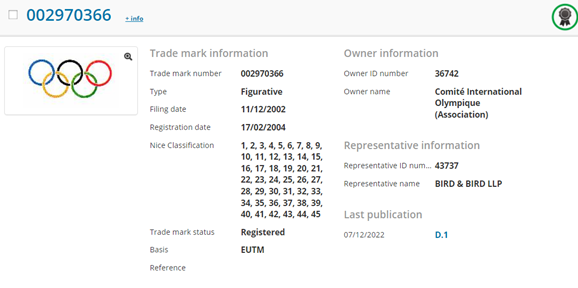
- Trademark rights protect the names, logos, symbols and slogans associated with an event. Examples include the name “Olympic Games” and “World Cup Qatar 2022,” which are owned by the IOC and FIFA, respectively. In addition, the iconic Olympic logo with the five rings also enjoys trademark protection. In Belgium, the Royal Belgian Football Association (KBVB) has registered the names “Red Devils” and variants thereof as trademarks.


- Copyrights provide protection for creative expressions such as photographs, logos, theme songs, television broadcasts, and the designs of mascots.

- Design rights apply to the design of products such as certain clothing, merchandising, medals and trophies.

- Portrait rights apply when a person is depicted in a recognizable manner, such as a photograph of an athlete during a sporting event.
Athletes themselves are also increasingly taking steps to protect their own name and image. For example, Cristiano Ronaldo, Lionel Messi and Usain Bolt, among others, protect their names as trademarks.

‘Ambush marketing’: a dangerous strategy
Intellectual property and portrait rights give the holder the exclusive right to determine who may use the protected logos, names, symbols, image and other elements, and under what conditions. This means they can prohibit third parties from using protected elements without their express permission.
Specifically, what does this mean? Thus, as a business, you may not simply use protected elements of a sporting event as part of your commercial marketing campaign.
If you do, you run the risk of being guilty of “ambush marketing. This is a marketing strategy in which a company promotes its products or services by linking – either explicitly or implicitly – to a specific event without paying the required permissions or compensation.
‘Ambush marketing’ can lead to litigation, damages and reputational damage. Therefore, as a business, it is essential to be aware of the rules so that you can respect them.
The key to a successful marketing campaign: Play fair and win!
Before creating a marketing campaign that capitalizes on a sporting event or occurrence, it is important to thoroughly consider the existence of intellectual property and portrait rights Always make sure you have the necessary permissions for the use of protected logos, names, effigies and slogans. Or choose alternative ways to incorporate the sporting atmosphere into your campaign without giving the false impression of a connection between your company and the sporting event in question (for example, by using generic sporting themes, without using specific names or logos).
In addition, it is also important to take into account other applicable regulations, such as laws on market practices and consumer protection and promotional games of chance (if, for example, you want to organize a prize draw).
With the right knowledge and preparation, you will set up a successful campaign that is both creative and legal. That way, you can take full advantage of the sporting atmosphere these events bring, without legal complications.
Want more information or legal guidance on setting up your marketing campaign? If so, please do not hesitate to contact us at IFORI. We also offer compliance & freedom to operate checks to ensure that your campaign does not violate third-party rights.